


One example
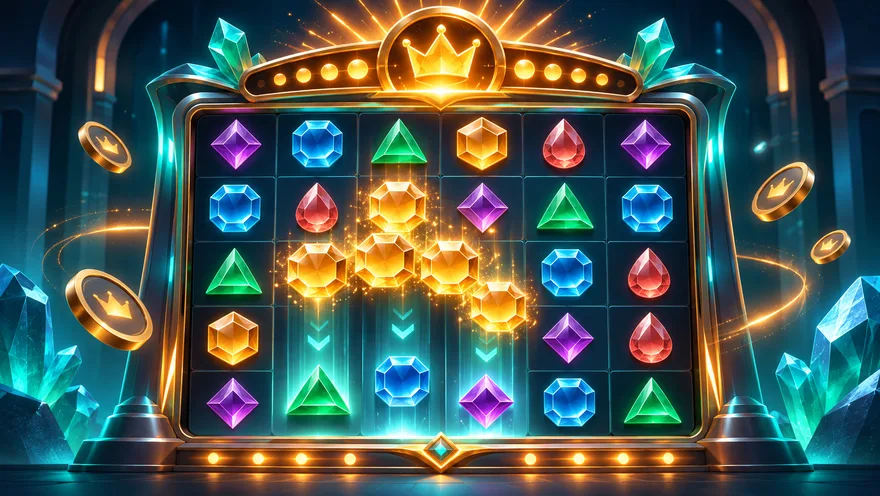
Imagine a 7-by-7 grid where five matching symbols are required. If five symbols connect edge-to-edge, the paytable may recognise one cluster. If two groups touch only at their corners and diagonal contact is excluded, they may remain separate or fail to qualify. This example illustrates adjacency; it is not a universal game rule.
Cascades
Many cluster games remove a winning group and let new symbols fall into the empty spaces. The grid is evaluated again, and the sequence continues until no new qualifying cluster forms. A game may increase a multiplier during the sequence, expand symbols or use another feature. Those additions are title-specific.
Cluster pays versus ways
| Cluster pays | Ways to win |
|---|---|
| Groups can form in several grid locations | matches usually cross adjacent reels |
| Adjacency can be horizontal/vertical | row position may not matter |
| Minimum cluster size controls qualification | minimum reel count controls qualification |
| Cascades are common | cascades may or may not appear |
What the label does not tell you
Cluster pays does not establish RTP, hit frequency, volatility or maximum win. Verify those in the specific game information. A large grid and frequent small visual matches can still coexist with a house edge.
GB game-cycle note
A cascade chain can form part of one game cycle. The GB online-slot stake cap applies to the total amount risked in that cycle, and the minimum speed controls still apply to starting the next cycle. Do not assume each visual drop is a new paid spin.
FAQ
Do diagonal symbols count?
Only if the game rules say so. Horizontal and vertical adjacency is common, but the paytable is authoritative.
Is a larger cluster always worth more?
Often the paytable scales with cluster size, but values and caps are game-specific.
Does a cascade improve RTP?
It is already part of the game’s mathematical model. The presence of cascades does not by itself make RTP higher.
Sources checked 18 November 2026
- Virgin Games editorial, how cluster-pays slots work, used as a mechanics comparison source.
- UK Gambling Commission, online slots stake-limit guidance.